INTERACTIVE LEARNING BY SWETAxAI

Where concepts come alive
Explore physics, mathematics, and science through immersive simulations, visual experiments, and interactive tools designed to turn curiosity into understanding.
Not just reading.
Not just watching.
Learning by doing.
Build intuition. Test ideas. See the invisible forces that shape the world.
Curricula Supported:
IB | IGCSE | GCSE | Edexcel | CBSE | and more
End Use Only: Licensed for authorised use by learners, teachers, schools, and institutions. Redistribution, resale, copying, or unauthorised sharing is strictly prohibited.
SWETAxAI FREE INTERACTIVE LEARNING MODULES
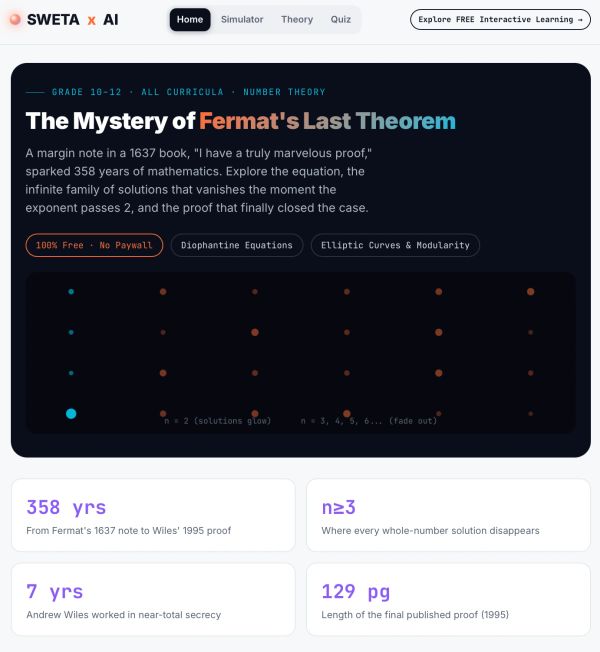
Fermat's Last Theorem — The Equation That Took 358 Years to Solve | SWETAxAI
Explore the most famous unsolved problem in mathematics history — for free, with no sign-up. This interactive module lets you search for whole-number solutions to aⁿ+bⁿ=cⁿ yourself, watch them vanish the moment the exponent passes 2, and generate exact Pythagorean triples using Euclid's ancient formula.
Follow the 358-year journey from Fermat's 1637 margin note to Andrew Wiles' 1994 proof, now updated with September 2026's landmark development, where Anthropic's Claude produced the first complete, computer-checked formalization of Wiles's proof in the Lean programming language.
Test your understanding with an 11-question quiz covering both the classical history and this new chapter. Built for Grade 10–12 students across all curricula (NCERT, IGCSE, IB, NEET, JEE).
🆓 100% FREE — no sign-up, no paywall, ever.
What is Fermat's Last Theorem?
Fermat's Last Theorem states that the equation aⁿ+bⁿ=cⁿ has no solutions in positive whole numbers a, b, and c when the whole-number exponent n is greater than 2.
Why is n = 2 an exception to Fermat's Last Theorem?
When n = 2, the equation becomes a²+b²=c², the Pythagorean theorem, which has infinitely many whole-number solutions called Pythagorean triples, such as (3, 4, 5) and (5, 12, 13). Fermat's claim applies only to exponents greater than 2.
Who proved Fermat's Last Theorem, and when?
British mathematician Andrew Wiles proved Fermat's Last Theorem, completing the work with former student Richard Taylor in 1994 after fixing a gap in his original 1993 announcement. The finished proof was published in 1995, 358 years after Fermat first stated the claim in 1637.
Did AI prove Fermat's Last Theorem?
No, Anthropic's Claude did not discover Fermat's Last Theorem or replace Andrew Wiles's mathematical breakthrough. In September 2026, Claude formalized Wiles's existing proof, translating it into the Lean programming language so a compiler could verify every logical step with zero gaps. This "machine-checked" version confirms Wiles's original work rather than creating a new one.
What does it mean to "formalize" a mathematical proof?
Formalising a proof means translating a human mathematician's argument into a formal programming language (such as Lean), where a compiler checks every logical step and either accepts the proof outright or rejects it, with no partial credit for a plausible-sounding but flawed step.
What is the connection between Fermat's Last Theorem and elliptic curves?
In 1984, mathematician Gerhard Frey showed that any hypothetical counterexample to Fermat's Last Theorem would produce an unusual elliptic curve. In 1986, Ken Ribet proved that curve could never be "modular," meaning a proof of the modularity theorem (Taniyama–Shimura conjecture) would automatically prove Fermat's Last Theorem — which is the path Wiles ultimately took.
Did Fermat actually have a proof of his theorem?
No mathematician has ever found the proof Fermat claimed to have in 1637. Most historians believe Fermat either made an error or was mistaken about having a complete proof, since the actual proof required 20th-century mathematics, elliptic curves and modular forms, that didn't exist for another three centuries.
Is this Fermat's Last Theorem module free to use?
Yes. The module is 100% free with no sign-up or paywall, and includes an interactive equation simulator, a Pythagorean triple generator, a seven-part theory walkthrough covering both the classical proof and the 2026 AI formalization, and an 11-question quiz.
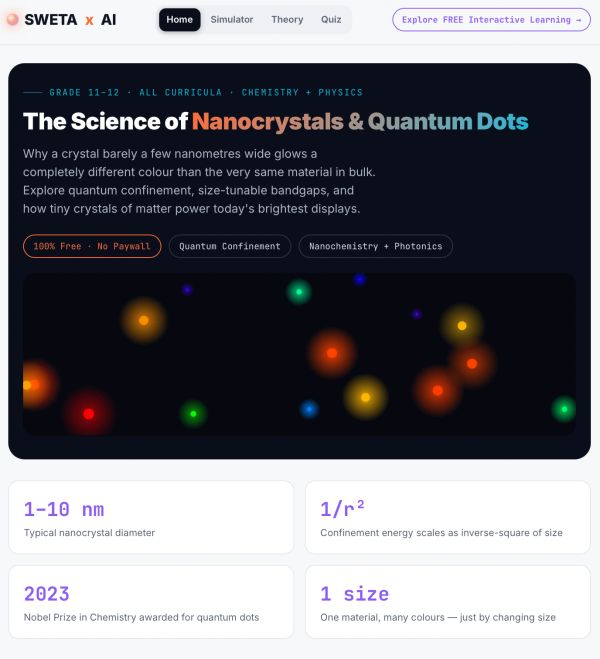
Nanocrystals & Quantum Dots: Why Size Changes Colour | SWETAxAI
A quantum dot is a semiconductor nanocrystal, typically 1–10 nanometres wide, that emits a different colour of light purely based on its size, a phenomenon called quantum confinement.
Shrinking the same material makes it glow bluer; growing it larger shifts the glow toward red. This free, interactive SWETAxAI module lets you tune a nanocrystal's radius on a live simulator, watch its emission wavelength shift in real time using the Brus equation, and run a virtual synthesis lab to grow quantum dots for a target display colour.
Includes a visual theory walkthrough covering excitons, core-shell passivation, and the 2023 Nobel Prize in Chemistry — plus an 11-question quiz to test understanding. Aligned to Grade 11–12 Physics and Chemistry across NCERT, NEET, JEE, IGCSE, and IB curricula. No sign-up, no paywall.
🆓 100% FREE — no sign-up, no paywall, ever.
FAQ:
What is a quantum dot?
A quantum dot is a semiconductor nanocrystal, usually 1–10 nanometres wide, that emits a specific colour of light determined by its size rather than its chemical composition alone.
Why do smaller nanocrystals emit bluer light?
Quantum confinement squeezes the electron-hole pair (exciton) into a smaller space, which raises its energy according to the Brus equation — and higher-energy photons correspond to shorter, bluer wavelengths of light.
What is quantum confinement?
Quantum confinement is the effect where restricting an electron to a space only a few nanometres wide — smaller than its natural exciton size — forces its allowed energy levels to become size-dependent, similar to a particle trapped in a box.
Who discovered quantum dots?
Alexei Ekimov and Louis Brus independently discovered size-dependent quantum effects in nanocrystals in the early 1980s, and Moungi Bawendi developed the hot-injection method for synthesizing them reliably; all three shared the 2023 Nobel Prize in Chemistry for this work.
What are quantum dots used for?
Quantum dots are used in display technology (QLED TVs), biological imaging, solar cells, and single-photon sources, because their emission colour can be precisely tuned just by controlling nanocrystal size during synthesis.
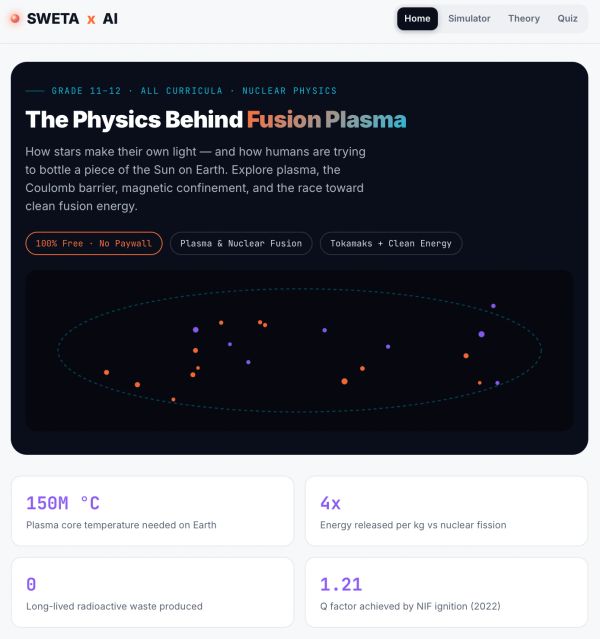
The Physics Behind Fusion Plasma | SWETAxAI
How does a star make its own light, and can we bottle that on Earth?
Explore plasma, the Coulomb barrier, quantum tunneling, and the magnetic fields that hold a 100-million-degree tokamak plasma in place.
Tune a live confinement simulator, test different fusion reactor designs against the Lawson breakeven line, and lock in the physics with an 11-question quiz.
🆓 100% FREE — no sign-up, no paywall, ever.
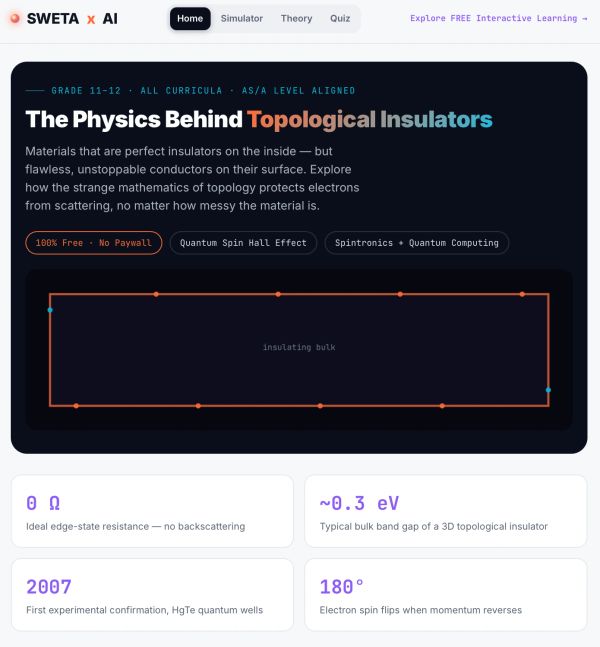
The Physics Behind Topological Insulators | SWETAxAI
Discover the materials that break the rules of ordinary conductors, perfect insulators on the inside, yet flawless conductors on their surface.
This free interactive module walks through band topology, time-reversal symmetry, and spin-momentum locking, showing exactly why electrons on a topological edge can't be knocked backward by everyday defects.
Tune a live phase simulator to flip a material between trivial and topological states, test an impurity-immune spintronic wire, and explore the real physics behind next-generation low-power electronics and quantum computing, all through hands-on simulations, illustrated theory, and an 11-question quiz.
Built for Grade 11–12 learners across AS/A Level and international science curricula.
🆓 100% FREE — no sign-up, no paywall, ever.
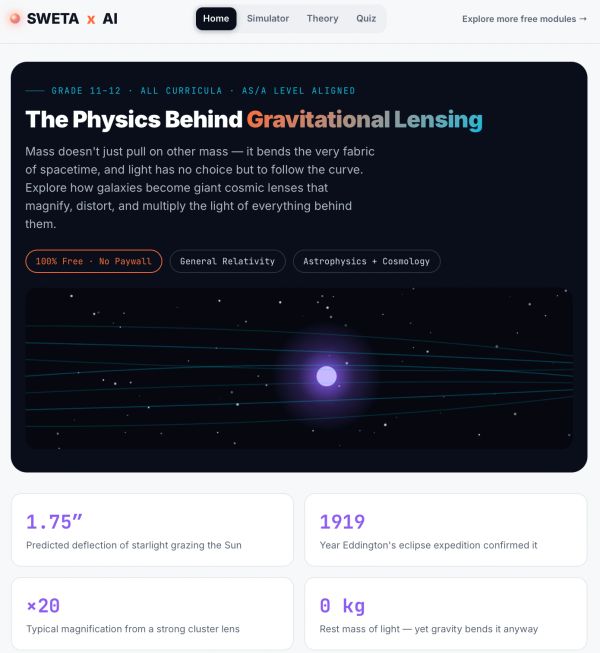
The Physics Behind Gravitational Lensing | SWETAxAI
Mass doesn't just attract — it curves spacetime itself, bending the path of light from everything behind it.
This interactive module lets Grade 11–12 students explore how galaxies act as cosmic lenses: drag a light ray past a massive object and watch it deflect using Einstein's own formula, form a complete Einstein ring, or split into multiple images.
A real-world microlensing simulator shows how astronomers use this same bending of light to detect exoplanets and invisible dark objects.
Includes a full theory walkthrough with illustrated diagrams and an 11-question quiz — free, with no sign-up required.
🆓 100% FREE — no sign-up, no paywall, ever.
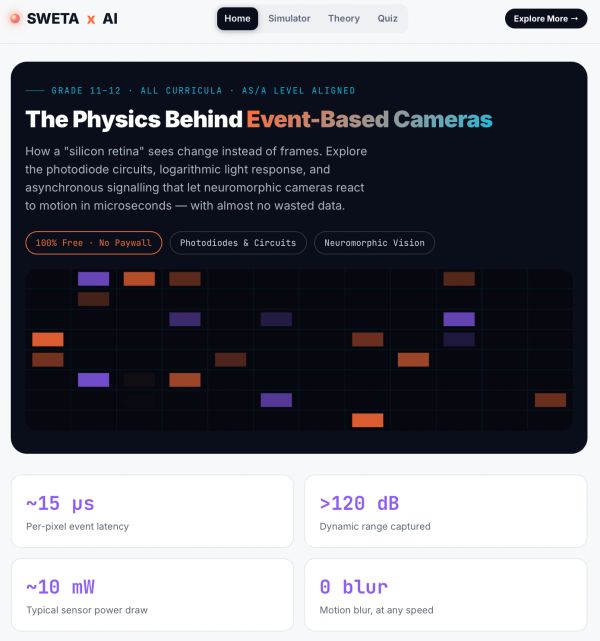
The Physics Behind Event-Based Cameras | SWETAxAI
Discover how a "silicon retina" sees the world — not in frames, but in change.
This free interactive module breaks down the photodiode circuits and logarithmic light response inside neuromorphic cameras, showing how each pixel independently fires microsecond-precise events the instant brightness shifts.
Simulate a real event-generating pixel, compare frame-camera blur against crisp event streams across four motion scenarios, and test your understanding with an 11-question quiz — all fully interactive, with zero sign-up required.
🆓 100% FREE — no sign-up, no paywall, ever.
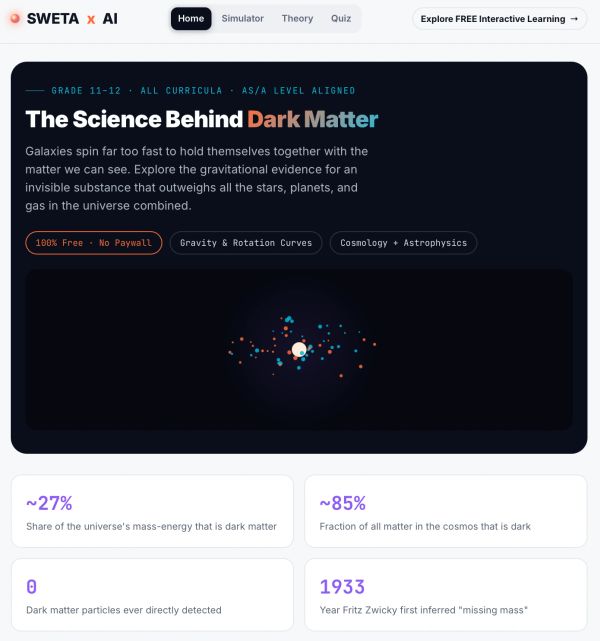
The Science Behind Dark Matter | SWETAxAI
Galaxies spin so fast that visible stars and gas alone can't hold them together, so what's really out there?
This interactive module walks through the gravitational evidence for dark matter, from Vera Rubin's rotation curve discovery to gravitational lensing and the Bullet Cluster.
Adjust a galaxy's dark matter halo and watch its rotation curve flatten to match real observations, then trace how light bends around a massive cluster.
Includes a fully illustrated theory section and an 11-question quiz to test what you've learned.
🆓 100% FREE — no sign-up, no paywall, ever.
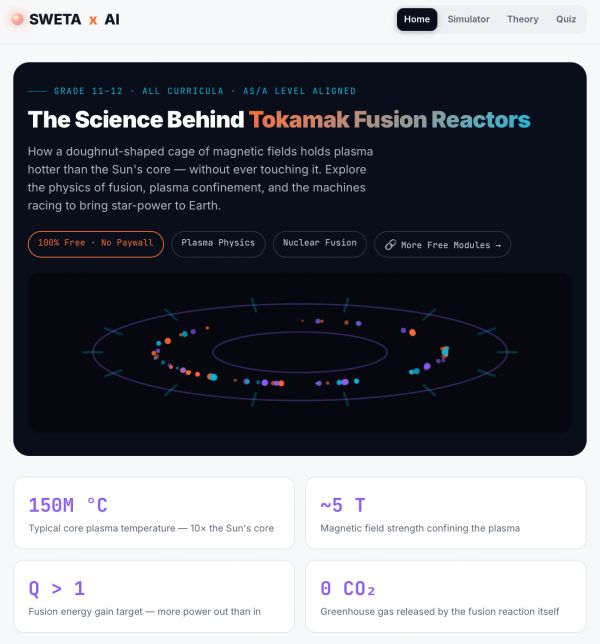
The Science Behind Tokamak Fusion Reactors | SWETAxAI
What if the same reaction powering the Sun could power your city?
Our newest FREE interactive module breaks down the physics of Tokamak Fusion Reactors, the doughnut-shaped machines racing to bring star-power to Earth.
Inside, students can:
- Tune magnetic fields in a live plasma confinement simulator and watch plasma stay centered — or drift into the wall
- Run a fusion power plant energy-balance sim and chase Q > 1 (more energy out than in)
- Explore 6 illustrated theory cards — from what plasma actually is, to how deuterium + tritium fuse into helium and energy
- Test their understanding with an 11-question quiz, complete with instant explanations
Perfect for Grade 11–12 students worldwide, aligned with AS/A Level, NCERT, NEET & JEE frameworks.
🆓 100% FREE — no sign-up, no paywall, ever.
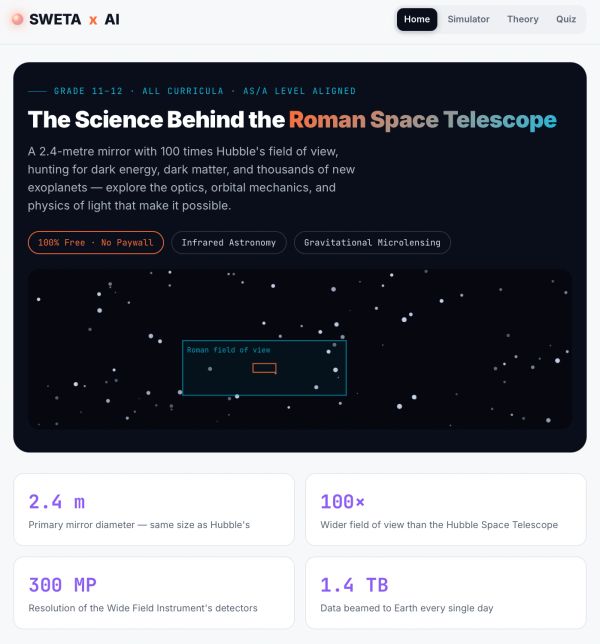
The Science Behind the Roman Space Telescope | SWETAxAI
NASA's Nancy Grace Roman Space Telescope just launched (Aug 30, 2026) on a mission to hunt for dark energy, dark matter, and thousands of new exoplanets. Now you can dive into the real physics that makes it possible, no textbook required.
🌌 What's inside this interactive module:
🔹 A 2.4m mirror with 100x Hubble's field of view — see why bigger "sight" changes everything
🔹 Hands-on Gravitational Microlensing Simulator — bend starlight yourself and spot a hidden exoplanet
🔹 Roman vs. Hubble Sky Survey Comparator — watch one telescope out-survey the other in real time
🔹 6 illustrated theory cards: infrared light, the coronagraph, the L2 orbit, and the hunt for dark energy
🔹 An 11-question quiz to test what you've learned
Built for Grade 11–12 students worldwide, aligned with AS/A Level, NCERT, NEET & JEE frameworks.
Perfect for students, self-learners, and educators who want to bring cutting-edge space science into the classroom — the same week it made headlines.
🆓 100% FREE — no sign-up, no paywall, ever.

The Physics Behind Hawking Radiation | SWETAxAI
Why aren't black holes completely black?
Turns out, quantum mechanics says they glow — very, very faintly.
Our newest FREE interactive module breaks down Hawking Radiation in a way every high schooler can actually understand:
🔹 Watch virtual particle pairs pop into existence right at the event horizon
🔹 Slide black hole mass up and down and see temperature + lifetime flip instantly
🔹 Run a real analogue black hole lab simulation — the same kind of experiment physicists used in 2016 to test Hawking's theory
🔹 6 illustrated theory cards + an 11-question quiz to lock it all in
Perfect for Grade 11–12 · AS/A Level · NCERT · NEET · JEE students
100% FREE. No sign-up. No paywall. Ever.

The Physics Behind Supercapacitors | SWETAxAI
Why can these devices charge in mere seconds and keep going for over a MILLION cycles, while batteries wear out so much faster?
The answer lies in the Electric Double Layer — and now you can explore it hands-on!
Inside this module:
- Play with a live charge/discharge simulator built on Q=CV and E=½CV²
- Watch a regenerative braking simulation power an electric bus in real time
- Learn why massive surface-area carbon electrodes change everything
- See exactly how supercapacitors stack up against batteries on power vs. energy density
- Put your understanding to the test with an 11-question quiz
Built for students everywhere in Grades 11–12, mapped to High School Physics and AS/A Level syllabi — with NCERT, NEET & JEE relevance built right in.
🆓 Always 100% FREE. No login. No paywall. No catch.

The Physics Behind Quantum Tunneling | SWETAxAI
Meet Quantum Tunneling — one of the strangest (and most useful) ideas in physics, now live as a FREE interactive module on SWETAxAI!
What's inside:
🔹 A live simulator where YOU control particle energy, barrier height & width, and watch the tunneling probability change in real time
🔹 A real-world Scanning Tunneling Microscope simulation — scan an atomic surface and build a tunneling-current image, just like real scientists do
🔹 8 beautifully illustrated theory cards — from the Schrödinger equation to alpha decay to how tunneling powers our Sun
🔹 An 11-question quiz with instant feedback to test what you've learned
Perfect for Grade 11–12 physics students everywhere, including AS/A Level learners (and yes, NCERT/NEET/JEE aspirants too
100% FREE. No sign-up. No paywall. Just open and learn.

The Physics Behind Single-Photon Detectors | SWETAxAI
How scientists can detect a SINGLE particle of light?
We're talking about tech sensitive enough to catch just ONE photon — the same physics powering unhackable quantum internet, self-driving car LiDAR, and medical scanners that save lives!
In this FREE interactive module, you'll get to:
- Fire photons at a real SPAD (Single-Photon Avalanche Diode) simulator and watch the avalanche happen in real time
- Run your own Quantum Key Distribution experiment — send secret photon-encoded messages and try to catch an eavesdropper red-handed!
- Explore beautifully illustrated theory cards on PMTs, SNSPDs, and quantum detection
- Test yourself with an 11-question quiz with instant feedback
From Einstein's Nobel Prize-winning photoelectric effect to cutting-edge quantum cryptography — this module makes it all click.
🆓 100% FREE. No sign-up. No paywall. Just pure physics, made interactive.
Perfect for Grade 11-12 students and AS/A Level learners everywhere!
Dive in now and see light like never before!

The Physics Behind Optical Neural Networks | SWETAxAI
What if a neural network could "think" using beams of light instead of electricity?
Introducing our newest FREE interactive physics module: The Physics Behind Optical Neural Networks!
Dive into the mind-bending world where light itself performs computation:
- See how Mach-Zehnder Interferometers turn light interference into trainable "weights"
- Simulate a real photonic image classifier — watch light diffract through layers to identify patterns
- Explore the math behind optical matrix multiplication happening at the speed of light
- Take an 11-question quiz to test what you've learned
- Journey through the history — from the first laser in 1960 to today's photonic AI chips
Perfect for Grade 11–12 students worldwide (AS/A Level aligned too!)
100% FREE — no sign-up, no paywall, ever.
Try it now and see how physics is powering the next generation of AI!

The Physics Behind Quantum Sensors | SWETAxAI
Ever wondered how scientists detect a SINGLE neuron firing in your brain? Or find a hidden sinkhole without digging a single hole?
Meet Quantum Sensors — devices so precise they use superposition and entanglement to measure magnetic fields, gravity, and time beyond what any classical instrument can touch!
Inside our new interactive module, you can:
- Run a live Ramsey interferometry lab — watch quantum precision beat classical limits in real time
- Drive a quantum gravimeter over buried objects and catch the anomaly yourself
- Explore NV-diamond magnetometers, SQUIDs, and atom interferometry with illustrated theory cards
- Test your knowledge with an 11-question quiz (instant feedback + explanations!)
100% FREE. No sign-up. No paywall. Ever.
Perfect for Grade 11–12 students worldwide — with AS/A Level, NCERT, NEET & JEE alignment built right in!
Dive in now and see the quantum world come alive!

The Physics Behind Solid-State Batteries | SWETAxAI
Ever wondered how future EVs could charge in minutes AND be safer than today's batteries?
Meet our brand-new interactive module: Solid-State Batteries!
Swap the flammable liquid electrolyte for a solid one, and watch what changes:
- Higher energy density = longer range
- No more dendrite fires
- Faster charging potential
Inside you can:
- Play with our Ion Transport Simulator — control temperature & voltage and watch Li⁺ ions hop through the solid lattice in real time
- Run a Real-World EV Application Simulator comparing solid-state vs. conventional Li-ion battery packs
- Explore theory cards with custom illustrations
- Test yourself with an 11-question quiz!
Perfect for Grade 11–12 students (AS/A Level & beyond) who want to see cutting-edge physics come alive in the browser.
100% FREE — no sign-up, no paywall, ever.
Dive in now and power up your understanding!

The Physics Behind Plasmonics | SWETAxAI
Ever wondered why the ancient Roman Lycurgus Cup changes color from green to red depending on the light?
The answer is nanoscience, and it's the same physics behind rapid COVID test strips, next-gen solar cells, and cancer photothermal therapy!
Introducing our newest interactive module: The Physics Behind Plasmonics
Inside you'll get:
- A live Surface Plasmon Resonance simulator — tune wavelength, particle size & material and watch electrons dance in real time
- A Real-World Biosensor simulator — see exactly how molecules binding to gold nanoparticles get detected
- 6 beautifully illustrated theory cards — from Mie theory to gold vs. silver nanoparticles
- An 11-question quiz to test what you've learned
Perfect for AS/A Level Physics students and anyone curious about nanotechnology!
100% FREE — no sign-up, no paywall, ever.

The Physics Behind Optical Tweezers | SWETAxAI
Ever wondered how scientists can grab a single strand of DNA... using nothing but LIGHT?
Meet the Nobel Prize-winning tech behind Optical Tweezers, a laser beam so precise it can trap a living cell without ever touching it!
Our new interactive module breaks it all down:
- How gradient & scattering forces create a "trap" of light
- A real DNA-stretching simulator — pull a strand and watch the force readout live!
- A cell-sorting chip simulation
- Full theory with visuals + an 11-question quiz to test yourself
Perfect for AS/A Level Physics students (and anyone curious about lasers + biophysics)!
🆓 100% FREE — no sign-up, no paywall, just click and explore.

The Physics Behind Atomic Clocks | SWETAxAI
Ever wondered how your phone's GPS knows exactly where you are? It all comes down to atoms ticking with insane precision!
Our brand-new interactive module, The Physics Behind Atomic Clocks — is LIVE!
Inside you'll get to:
- Tune a cesium atom's microwave frequency and watch resonance happen in real time
- Run a GPS satellite simulator and see how nanosecond clock errors turn into meters of position error
- Explore the exact frequency (9,192,631,770 Hz!) that literally defines a second
- Test yourself with an 11-question quiz
Built for Grade 11–12 students following AS/A Level Physics (and great NCERT/NEET/JEE revision too)
100% FREE — no sign-up, no paywall, just click and learn!
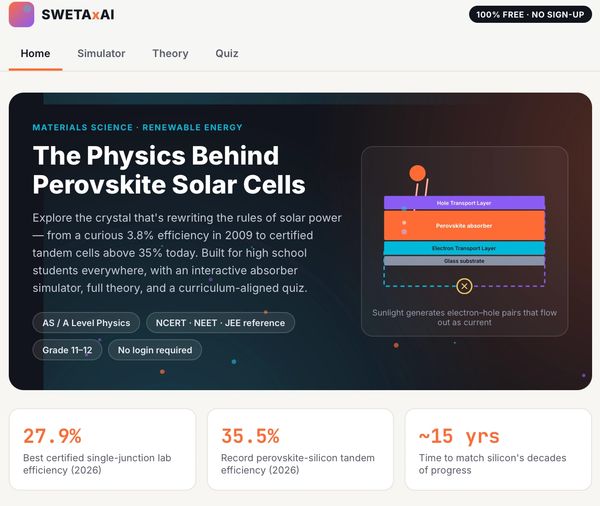
The Physics Behind Perovskite Solar Cells | SWETAxAI
What if the future of solar power came from a material first found in a Russian mountain in 1839?
Meet the perovskite solar cell, the tiny crystal structure that's shaking up renewable energy! From a shy 3.8% efficiency in 2009 to record-breaking 35%+ tandem cells today, perovskites are catching up to 70 years of silicon research... in just 15 years.
Our newest interactive module breaks it all down for Grade 11-12 students:
- Play with a live absorber simulator — tune wavelength & bandgap and watch electrons and holes generate in real time
- Learn the physics — crystal structure, the photovoltaic effect, and why tandem cells smash the single-junction limit
- Test yourself with an 11-question quiz
Perfect for AS/A Level Physics students, with NCERT/NEET/JEE relevance too!
100% FREE — no sign-up, no paywall, just open and explore.
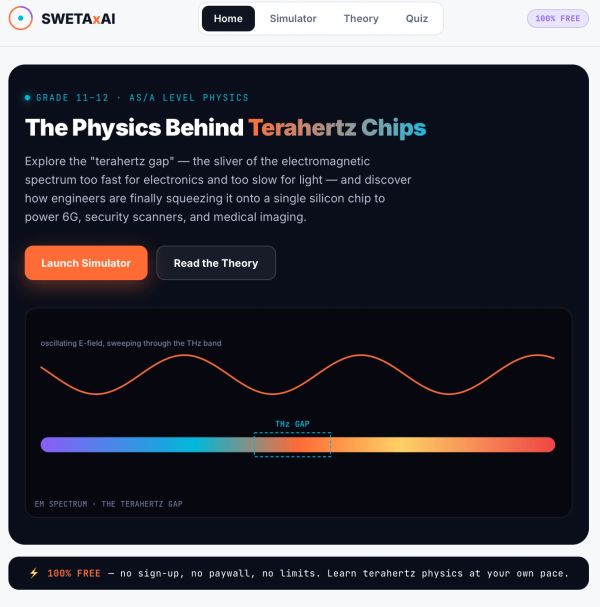
The Physics Behind Terahertz Chips | SWETAxAI
Say hello to Terahertz Chips — the tiny tech squeezing a "forbidden" slice of the electromagnetic spectrum onto a single silicon chip!
In our brand new interactive module, you can:
- Explore the mysterious "terahertz gap" — the zone between microwaves and infrared light that stumped scientists for decades
- Play with a live THz Wave Generator — fire waves at cardboard, metal, water & ceramic and watch physics happen in real time
- Step into an Airport THz Body Scanner simulation — see exactly how security tech spots hidden objects WITHOUT harmful radiation
- Learn the theory behind 6G networks, medical imaging & chemical fingerprinting — all with custom illustrations
- Test your knowledge with an 11-question quiz!
Perfect for AS/A Level Physics students (and anyone who loves cutting-edge science)
🆓 100% FREE — no sign-up, no paywall, ever.

Silicon Photonics: How Chips Trap and Steer Light | SWETAxAI
Ever wondered how your internet data travels at the speed of light... literally?
Meet Silicon Photonics, the physics of trapping light inside chips thinner than a human hair, using nothing but silicon and glass!
In our newest interactive module you can:
- Play with a live Total Internal Reflection simulator, tweak the angle and watch light get trapped (or escape!)
- Explore beautiful visual diagrams explaining waveguides, Snell's Law & critical angle
- Test yourself with an 11-question quiz
- Fully aligned with AS/A Level Physics (plus NCERT/JEE/NEET touchpoints)
This is the same tech powering data centers, self-driving car LiDAR, and even future quantum computers, and you can explore it for 100% FREE. No sign-up. No paywall.
Perfect for Grade 11-12 students anywhere in the world who want physics to actually make sense.

The Physics Behind Metamaterials: Interactive Simulations for High School Students | SWETAxAI
Ever wondered how scientists could build an "invisibility cloak"?
Meet metamaterials, engineered structures that bend light in ways no natural material ever could!
In our newest interactive module, you'll:
- Watch light bend the "wrong" way with negative refraction
- See how split-ring resonators create artificial magnetism
- Play with a real invisibility cloak simulator, toggle it ON and watch an object disappear
- Test yourself with an 11-question quiz
Whether you're prepping for AS/A Levels or just love mind-bending physics, this one's for you, with two full interactive simulations and animated visuals to make the concepts click.
100% FREE. No sign-up. No paywall. Just open and explore.
Dive in now and see physics that breaks the rules!

The Physics Behind Quantum Dots — Why Size Alone Changes Color | SWETAxAI
Ever wondered why the exact same material can glow red, green, or blue, with nothing changed except its SIZE?
Meet the quantum dot: a semiconductor crystal so tiny (2-10 nanometres!) that normal physics rules start bending. Shrink it down, and the color it emits shifts like magic, from red, to orange, to green, to blue.
This isn't sci-fi. It's the exact same tech powering:
- QLED TVs with insanely accurate color
- Next-gen solar cells
- Medical imaging that doesn't fade
- Early quantum computing research
We turned this mind-bending physics into a FREE interactive module, drag a slider, watch the dot change color in real time, and see WHY it happens with the actual quantum confinement equation. Then test yourself with an 11-question quiz!
🔓 100% FREE. No sign-up. No paywall. Ever.
Perfect for Grade 11-12 students — maps straight onto AS/A Level Quantum Phenomena, and NCERT/NEET/JEE nanomaterials topics too.

The Physics Behind Terahertz Waves — Interactive Simulator, Theory & Quiz | SWETAxAI
Ever wondered how airport scanners "see" through your clothes without any harmful radiation?
Meet the Terahertz wave, the physics hiding in the gap between microwaves and infrared light!
For decades, scientists called this the "terahertz gap" because it was too fast for electronics and too slow for lasers.
Today it's everywhere:
- Security scanners,
- Cancer-detecting imagers,
- Counterfeit-drug detection,
- Art restoration, and even the
- 6G networks of tomorrow!
We just dropped a FREE interactive module breaking it all down, a live wave simulator, visual theory with diagrams, and an 11-question quiz to test yourself.
🆓 100% FREE — no sign-up, no paywall, ever.
Perfect for Grade 11–12 students (AS/A Level, NCERT, NEET & JEE aligned too)
Explore it now and see the invisible spectrum come alive!

Quantum Radar Physics — How Entangled Photons Detect Hidden Targets | SWETAxAI
Ever wonder how radar could one day "see" a target that's practically invisible?
Enter Quantum Radar, where physicists fire entangled photon pairs into the void, keep one twin safe at home, and use quantum correlation to catch echoes that classical radar would completely miss in the noise.
We just dropped a FREE interactive module breaking it all down:
- Why classical radar has a hard detection limit
- What quantum entanglement actually is (explained simply!)
- The quantum illumination protocol, the trick that beats stealth & jamming
- A live simulator where YOU control the noise, target reflectivity & entanglement quality
- A quiz to test what you've learned
No sign-up. No paywall. Just physics.
Perfect for AS/A Level students, and lines up beautifully with NCERT/NEET/JEE modern physics too.
Go play with the simulator!

Neuromorphic Computing Explained: The Physics of Brain-Inspired Chips | SWETAxAI
Your brain runs on just 20 watts, about as much as a dim light bulb, and it still out-thinks every supercomputer on the planet at recognizing faces, sounds, and patterns.
How?
The secret is neuromorphic computing, chips designed to work like real neurons instead of traditional processors.
We just dropped a brand new interactive module that breaks down the physics behind it, and you can explore it for free right now
- Watch a live spiking neuron simulator, tweak the current, threshold, and leak rate and see it fire in real time
- Learn how memristors give hardware a physical memory
- See why event-driven chips use 1000x less power than a GPU on some tasks
- Test yourself with a quiz at the end
100% FREE — no sign-up, no paywall, ever.
Perfect for curious minds and physics students in Grade 11–12 alike.

Quantum Internet Physics — Quantum Entanglement, QKD & Quantum Cryptography Explained | SWETAxAI
What if hacking the internet became physically impossible?
That's not sci-fi, it's the promise of the Quantum Internet, and the physics behind it is wild. Entangled photons. Unbreakable encryption. Signals that get "damaged" the moment someone tries to spy on them.
We just dropped a fully interactive module breaking it all down, and yes, you can actually run a quantum eavesdropping simulation yourself.
What's inside:
- How quantum entanglement really works (no jargon, promise)
- A live simulator, send photons from Alice to Bob and watch Eve get caught in the act
- The "no-cloning theorem", the one rule that makes quantum hacking impossible
- Why satellites beat fiber-optic cables for long-distance quantum links
- An 8-question quiz to test what you've learned
100% FREE — no sign-up, no paywall, just click and explore.
Whether you're prepping for exams or just quantum-curious, this one's for you.

Spintronics Explained: Electron Spin, GMR & Spin Valves | SWETAxAI
Did you know electrons carry a hidden "compass" inside them — and it's powering your hard drive right now?
It's called spin, and the science built around it, Spintronics, is one of the coolest (and most underrated) corners of modern physics. It's how your laptop stores data, how MRI machines work their magic, and where the next generation of ultra-fast memory chips are headed.
We just dropped a full interactive module on it, and it's 100% FREE to explore
What's inside:
- Live Spin Valve Simulator, flip magnetic layers and watch electron spins scatter (or not!) in real time
- 8 theory cards, from electron spin basics to Spin Transfer Torque
- Instant-feedback quiz to test what you've learned
- A timeline of spintronics milestones (Nobel Prize included!)
- 100% FREE ACCESS, no sign-up, no paywall, ever.
Perfect for curious minds, AS/A Level, NCERT, NEET & JEE physics students who want to actually see the physics instead of just memorizing it.

Room-Temperature Superconductors: Zero Resistance Physics Explained Interactively | SWETAxAI
Can a material carry electric current forever with zero energy loss?
Meet Room-Temperature Superconductors, one of physics' biggest open races, and our newest FREE interactive module!
Inside, you can:
- Simulate resistance dropping to zero as temperature falls below Tc
- Explore the Meissner Effect, the "floating magnet" trick
- Learn how Cooper Pairs let electrons glide without scattering
- See real materials compared: Mercury, YBCO, H₃S & LaH₁₀
- Test yourself with an instant-feedback quiz
100% FREE ACCESS, no sign-up, no paywall
Great for curious minds + aligned with NCERT/NEET/JEE physics

Photonic Computing Explained: The Physics of Light-Based Computers| SWETAxAI
Discover how photonic computing uses light instead of electricity to process information at incredible speeds.
This free interactive physics module explores how photons travel through waveguides using total internal reflection, how wave interference performs computation, and how a Mach-Zehnder interferometer switches light between logical "0" and "1" states.
Featuring a live drag-and-slide simulator, in-depth theory cards, and a scored quiz, this module makes modern optics and wave physics concepts accessible for high school students worldwide — completely free, with no sign-up required.
Also aligned with NCERT, NEET, and JEE physics syllabi.

The Physics Behind Exoplanets: Free Interactive Transit & Radial Velocity Simulator | SWETAxAI
Explore the real physics used to detect planets orbiting distant stars with this free, interactive exoplanet module for high school students.
Learn how the transit method reveals a planet's size from a tiny dip in starlight, how radial velocity uses the Doppler effect to detect a star's gravitational wobble, and how Kepler's Third Law connects orbital period to distance and stellar mass.
Adjust planet radius, orbital distance, and mass in a live simulator to see light curves and Doppler shifts respond in real time, then test your understanding with a scored quiz.
Also relevant for NCERT, NEET, and JEE physics and astrophysics preparation. 100% free access — no sign-up, no paywall.

The Physics Behind Antimatter — Interactive Module for High School Students | SWETAxAI
Explore antimatter physics through a free, interactive simulation built for Grade 11–12 students.
Discover how Dirac's equation predicted the existence of antimatter in 1928, run a live electron-positron annihilation simulator to see E=mc² in action, and learn how this cutting-edge physics powers real-world technology like PET scans.
Master core Modern Physics concepts — particle-antiparticle pairs, pair production, and the unsolved matter-antimatter asymmetry problem — through hands-on simulation, in-depth theory, and a self-check quiz. 100% free, with no sign-up required.
Aligned with NCERT, NEET, and JEE curricula.

Vikram-1: Inside India's First Private Orbital Rocket Launch — Free Interactive Physics Module | SWETAxAI
Explore how Skyroot Aerospace's four-stage Vikram-1 rocket reached orbit on its historic debut flight, Mission Aagaman.
This free, interactive module breaks down multi-stage rocket physics, the Tsiolkovsky rocket equation, solid vs. liquid propulsion, thrust vector control, and orbital mechanics — with a live launch telemetry simulator and self-check quiz.
No sign-up, no paywall, 100% free access for students everywhere. Aligned with NCERT, NEET, and JEE physics curricula.

Nuclear Fusion Energy Explained — Interactive Physics Simulator for High School Students | SWETAxAI
Explore the physics behind fusion energy with a free, interactive simulator that lets you control plasma temperature and density to trigger real nuclear fusion reactions.
Learn how the Sun generates energy, why the Coulomb barrier makes fusion so difficult to achieve, and how the Lawson Criterion defines the path to breakeven energy gain, the same challenge facing reactors like ITER. Includes clear theory notes on mass-energy equivalence, deuterium-tritium reactions, and plasma physics, plus a 5-question quiz to test your understanding.
Designed for Grade 11–12 physics students worldwide, with topics aligned to NCERT, NEET, and JEE syllabi.

How Nuclear Batteries Work: Radioactive Decay, RTGs & Betavoltaic Power Explained | SWETAxAI
Discover the physics powering Voyager 1, Mars rovers, and decades-long medical implants — with zero moving parts and no recharging. T
his free interactive module breaks down how nuclear batteries turn radioactive decay into usable electricity, covering half-life and exponential decay, the Seebeck effect behind radioisotope thermoelectric generators (RTGs), and the betavoltaic effect used in micro-scale power cells.
Explore a live isotope decay simulator, compare Plutonium-238, Americium-241, Strontium-90, Nickel-63, and Tritium side by side, and test your understanding with an instant-feedback quiz.
Built for high school physics students worldwide, with topics relevant to NCERT, NEET, and JEE preparation.

The Physics Behind the Higgs Boson| SWETAxAI
Discover how the Higgs field gives mass to the particles that make up everything around us.
This interactive High School Physics module breaks down the Higgs boson, the Higgs mechanism, and its historic 2012 discovery at the Large Hadron Collider, with a hands-on field simulator, clear theory explanations, and an instant-feedback quiz.
Perfect for Grade 11–12 students exploring Modern Physics, with relevance to NCERT, NEET, and JEE preparation.

The Physics Behind Hydrogen Fuel Cells | SWETAxAI
Explore how hydrogen fuel cells convert chemical energy directly into electricity through a simple electrochemical reaction, no combustion, no emissions, just water as the byproduct.
This interactive High School Physics module breaks down the anode and cathode reactions, the role of the proton exchange membrane, and how electron flow generates real electrical current.
With a hands-on simulator, structured theory cards, and an instant-feedback quiz, students build a clear, visual understanding of the electrochemistry powering hydrogen cars, buses, and even spacecraft.
Ideal for Grade 11–12 Physics and Chemistry learners, with relevance to NCERT, NEET, and JEE electrochemistry topics.

The Physics Behind the James Webb Space Telescope | SWETAxAI
Discover the real science powering humanity's most advanced space observatory.
This interactive module breaks down cosmological redshift, segmented mirror optics, Lagrange point orbital mechanics, and multi-layer thermal shielding through hands-on simulators, structured theory cards, and an instant-feedback quiz — built for Grade 11–12 High School Physics students who want to understand modern astrophysics beyond the textbook.
Explore why infrared light reveals the universe's earliest galaxies, how 18 mirror segments align into one perfect telescope, and why JWST orbits 1.5 million km from Earth.
A valuable resource for NCERT, JEE, and NEET physics revision on modern physics and optics.

The Physics Behind Quantum Sensors: How Atoms Detect the Undetectable | SWETAxAI
Explore how quantum sensors use superposition, phase accumulation, and entanglement to measure magnetic fields, gravity, and time with a precision no classical instrument can match.
This interactive module breaks down the physics of atomic clocks, SQUID magnetometers, NV-diamond sensors, and atom interferometers through a hands-on Ramsey interference simulator, structured theory cards, and an instant-feedback quiz.
Built for high school physics students exploring modern physics, quantum mechanics, and the science behind next-generation sensing technology.

The Physics Behind MRI: How Magnets and Radio Waves See Inside the Human Body | SWETAxAI
Ever wondered how an MRI scanner creates detailed images of your body without a single X-ray?
Explore the real physics behind Magnetic Resonance Imaging, nuclear spin, magnetic field alignment, Larmor precession, and RF resonance, through a fully interactive simulator built for High School Physics students (Grades 11–12).
Adjust magnetic field strength, fire an RF pulse, and watch protons align, tip, and relax in real time, then test your understanding with an instant-feedback quiz.
A hands-on way to master magnetism, resonance, and relaxation, core topics for NCERT, JEE, and NEET physics.

The Physics Behind Dark Matter — Interactive High School Physics Module | SWETAxAI
Explore one of the biggest unsolved mysteries in physics with this free interactive dark matter simulator.
Designed for Grade 11–12 high school physics students, this module breaks down galaxy rotation curves, gravitational lensing, and the evidence behind dark matter through a hands-on, self-paced learning experience.
Adjust the dark matter halo mass in real time, watch rotation curves change, and understand why scientists believe 27% of the universe is made of invisible matter.
Includes structured theory notes, key formulas, and an instant-feedback quiz to reinforce concepts, perfect for building a strong foundation in gravitation and modern astrophysics. A useful conceptual resource for NCERT, NEET, and JEE physics preparation.

Newton's First Law of Motion — Interactive Inertia Simulator for High School Physics | SWETAxAI
Explore why objects resist changes to their motion with a hands-on Newton's First Law simulator built for high school physics students.
Launch a puck across adjustable friction surfaces, simulate zero-friction deep space, and watch inertia play out in real time, no textbook diagrams required.
Master core concepts like net force, velocity, and the law of inertia through interactive experimentation, clear theory breakdowns, and a self-check quiz with instant feedback.
Perfect for building an intuitive, lasting understanding of forces and motion, including topics relevant to NCERT, NEET, and JEE physics syllabi.

Newton's Second Law of Motion — Interactive Force Simulator for High School Physics | SWETAxAI
Discover why heavier objects accelerate slower with an interactive Newton's Second Law simulator built for high school physics students.
Set the applied force and the mass in the Force Lab, then watch the cart continuously speed up, a live demonstration that constant force means constant acceleration, not constant speed.
Master core concepts like the F = ma relationship, the proportionality between force and acceleration, and the inverse relationship between mass and acceleration, through hands-on experimentation, clear theory breakdowns, and a self-check quiz with instant feedback.
Perfect for building a lasting, intuitive grasp of forces and motion — including topics relevant to NCERT, NEET, and JEE physics syllabi.
Newton's Third Law of Motion — Interactive Action-Reaction Simulator for High School Physics | SWETAxAI
Discover why every push has a push back with an interactive Newton's Third Law simulator built for high school physics students.
Push two skaters apart in the Recoil Lab, adjust their relative mass, and watch the forces stay perfectly equal and opposite, even as their resulting speeds differ.
Master core concepts like action-reaction pairs, force symmetry, and why these forces never cancel out, through hands-on experimentation, clear theory breakdowns, and a self-check quiz with instant feedback.
Perfect for building a lasting, intuitive grasp of forces and motion, including topics relevant to NCERT, NEET, and JEE physics syllabi.
Microlearning: One Concept at a Time (How it works?)

The Physics of Gravitational Waves: Interactive Spacetime Simulator | SWETAxAI
Explore how Einstein's General Relativity predicts ripples in spacetime with SWETAxAI's interactive gravitational waves module.
Simulate a binary black hole merger, adjust mass and orbital separation to watch the gravitational wave "chirp" unfold in real time, and see how LIGO's laser interferometry detects strains smaller than a proton.
Includes in-depth theory on spacetime curvature, wave generation, and multi-messenger astronomy, plus a 5-question quiz to test your understanding.
Designed for Grade 11–12 High School Physics students, and aligned with NCERT, JEE, and NEET preparation.

The Physics Behind MRI: How Magnets and Radio Waves See Inside the Human Body | SWETAxAI
Ever wondered how an MRI scanner creates detailed images of your body without a single X-ray?
Explore the real physics behind Magnetic Resonance Imaging, nuclear spin, magnetic field alignment, Larmor precession, and RF resonance, through a fully interactive simulator built for High School Physics students (Grades 11–12).
Adjust magnetic field strength, fire an
RF pulse, and watch protons align, tip, and relax in real time, then test your understanding with an instant-feedback quiz.
A hands-on way to master magnetism, resonance, and relaxation, core topics for NCERT, JEE, and NEET physics.

The Physics Behind Brain-Computer Interfaces | SWETAxAI
Discover how the brain's electrical signals become machine commands.
This interactive High School Physics module breaks down the real science of Brain-Computer Interfaces, from ion-driven action potentials and EEG electrode physics to signal amplification and Fourier analysis.
Built for Grade 11-12 learners exploring modern physics and signal processing, with an adjustable brainwave simulator covering delta, theta, alpha, beta, and gamma bands. Also relevant for NCERT, NEET, and JEE preparation.

The Physics Behind Hydrogen Fuel Cells | SWETAxAI
Explore how hydrogen fuel cells convert chemical energy directly into electricity through a simple electrochemical reaction, no combustion, no emissions, just water as the byproduct.
This interactive High School Physics module breaks down the anode and cathode reactions, the role of the proton exchange membrane, and how electron flow generates real electrical current.
With a hands-on simulator, structured theory cards, and an instant-feedback quiz, students build a clear, visual understanding of the electrochemistry powering hydrogen cars, buses, and even spacecraft.
Ideal for Grade 11–12 Physics and Chemistry learners, with relevance to NCERT, NEET, and JEE electrochemistry topics.
Graphene: The Strongest Material Ever Isolated | SWETAxAI
Discover graphene, a single layer of carbon atoms arranged in a hexagonal lattice, only one atom thick.
This interactive module breaks down sp² hybridization, delocalized electron conduction, and why graphene outperforms steel, silicon, and diamond in different ways.
Rotate a live 3D lattice simulator, study illustrated theory cards, and test your understanding with a randomized quiz — built for high school physics and materials science students.

The Physics Behind Electric Vehicles | SWETAxAI
Discover how magnetic force, electromagnetic induction, and energy conversion power modern electric vehicles.
This interactive module breaks down DC motor torque, battery energy storage, and regenerative braking through hands-on simulators, clear visual explanations, and a self-check quiz, built for Grade 11-12 High School Physics students exploring real-world applications of electromagnetism.
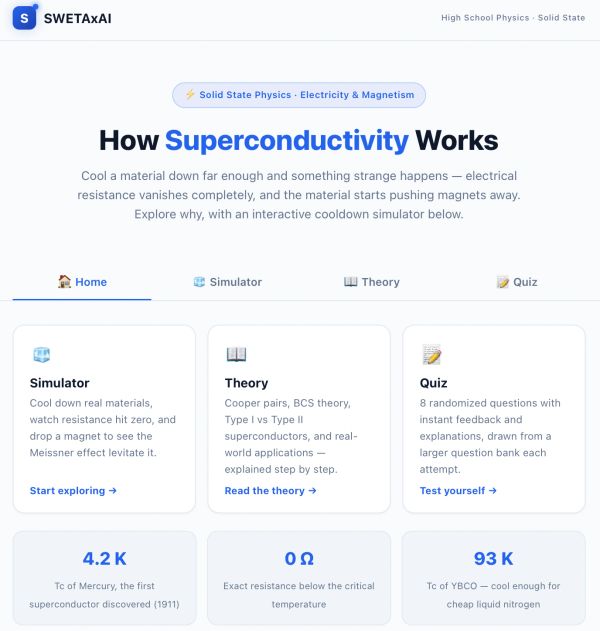
How Superconductivity Works — Interactive Physics Simulator | SWETAxAI
Discover what happens when electrical resistance disappears completely.
This interactive physics module lets students cool real superconducting materials, mercury, lead, niobium-tin, and high-temperature YBCO ceramic and watch resistance drop to exactly zero at the critical temperature (Tc).
Explore the Meissner effect with a live magnetic levitation simulation, understand how Cooper pairs form through BCS theory, and see why superconductors expel magnetic fields entirely.
The module covers Type I vs Type II superconductors, real-world applications including MRI machines, maglev trains, and particle accelerators, plus a randomized quiz with instant feedback to test understanding.
Built for high school physics students worldwide (Grade 11–12 level), with content also aligned to NEET, JEE, and NCERT curricula. No login required — explore directly in your browser.

Explore How Space Travel Works — Interactive Science Module | SWETAxAI
Learn how rockets launch, orbit, and travel through space with SwetaxAI's interactive module. Animations, simulators & quizzes for Class 11 & 12, NEET & JEE.
From rocket anatomy to orbital mechanics, this interactive module breaks down every stage of space travel — visually, physically, and interactively.
Click through a real rocket's components, watch launch physics simulate in real time, explore propellant types, and test your knowledge with a built-in quiz.
Built for Class 11 & 12 students preparing for NEET and JEE, and aligned with NCERT Physics concepts including gravitation, laws of motion, and modern applications of science.
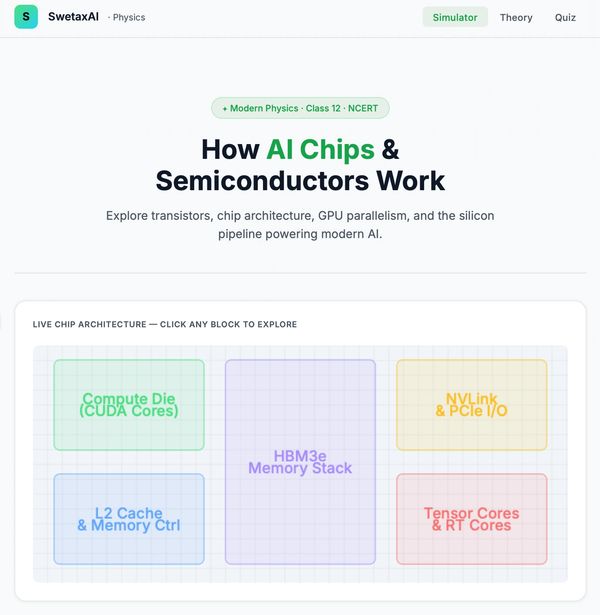
Understand AI Chips & Semiconductors — Visually, Interactively | SWETAxAI
Every AI model you've ever used, from ChatGPT to Google Search, runs on silicon. But how does sand become a chip capable of a trillion operations per second?
This interactive module answers that question from the ground up, starting with the physics of semiconductors and building all the way to the billion-transistor AI accelerators powering today's technology.
Begin with the fundamentals: what makes silicon a semiconductor, how doping creates N-type and P-type regions, and why a MOSFET transistor can switch between 0 and 1 billions of times per second. Then zoom out to architecture, explore an interactive chip diagram showing how Compute Dies, Tensor Cores, HBM3e memory stacks, and high-speed NVLink interconnects work together inside a modern GPU like the NVIDIA H100.
Every topic is aligned with the NCERT Class 11 and Class 12 Physics syllabus, covering semiconductor theory, p-n junctions, transistor operation, and modern electronics — exactly what JEE and NEET students need. Test your understanding with a randomised 10-question quiz drawn from a 15-question bank, with instant explanations after every answer.
No passive reading. No static diagrams. Just click, simulate, and understand.

How Lasers Work — Interactive Physics Simulation | SWETAxAI
Explore the physics behind lasers through an interactive simulation covering pumping, population inversion, stimulated emission, and optical cavities.
Designed for high school students (Grade 11–12), this module breaks down core laser concepts, coherence, monochromaticity, and collimation with animated diagrams and a 20-question practice quiz.
Perfect for building a strong foundation in modern physics and optics.

Fiber Optics & Total Internal Reflection — Interactive Physics Simulator | SWETAxAI
Explore how optical fibers trap and guide light using total internal reflection, the same physics that powers the internet.
This free interactive simulator lets high school students (Grades 11–12) drag the angle of incidence to see refraction flip into total internal reflection in real time, fire light pulses down a virtual fiber strand, and test their understanding with a randomized physics quiz.
Covers Snell's Law, the critical angle formula, refractive index, and core-cladding fiber design, ideal for CBSE, NCERT, IB, and general high school physics curricula.

Solar Cells Explained: How Photovoltaic Cells Convert Sunlight into Electricity | SWETAxAI
Discover how solar cells work with this free interactive physics simulator built for high school students.
Explore the photovoltaic effect in real time, adjust sunlight intensity, load resistance, and panel angle to see electrons flow across a p–n junction and watch a live current-voltage (I-V) curve update instantly.
Compare silicon, CdTe, and perovskite solar cell materials, master the solar cell equation and band gap concepts, then test your understanding with an interactive quiz.
Perfect for Grade 11–12 physics students studying semiconductors, renewable energy, and modern physics.